Learn Korean with Twenty-Five Twenty-One: Words and Level
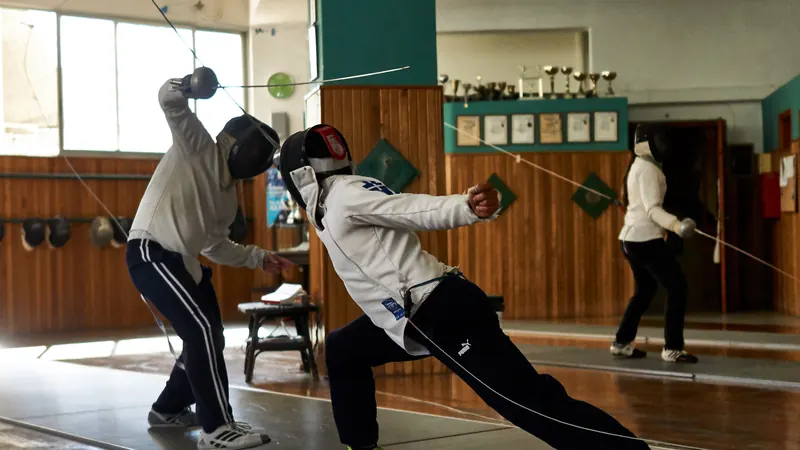
If you want to learn Korean with Twenty-Five Twenty-One, you've chosen one of the most approachable K-dramas of the 2020s: short, emotional lines, a small main cast and vocabulary that stays close to school, sport and family. This guide gives you its level, 32 words that recur in the show, notes on banmal and 1998 Korea, and a 16-episode plan with hours.
Short answer: Twenty-Five Twenty-One (스물다섯 스물하나) is an upper-beginner to lower-intermediate drama, about TOPIK 2–3. It has 16 episodes of roughly 80 minutes, about 21 hours. Start with English subtitles, switch to Korean ones by episode 3, and learn the fencing and school words first.
On this page
Is Twenty-Five Twenty-One good for learning Korean?
Yes, it's one of the best first full dramas for learners. It is 1998, Korea is in the middle of the financial crisis, and Na Hee-do's school cuts its fencing team. She transfers to Taeyang High School to keep fencing next to her idol, Ko Yu-rim. Baek Yi-jin, whose wealthy family has just gone bankrupt, is starting over with part-time jobs. In the present day, Hee-do's daughter finds her mother's old diary.
For learners, the show is built on short, emotional lines and a lot of repetition: training, competing, losing, cheering each other on. It's on our list of K-dramas for beginner Korean learners for that reason.
| Twenty-Five Twenty-One | |
|---|---|
| Korean title | 스물다섯 스물하나 (Seumuldaseot Seumulhana, "twenty-five, twenty-one") |
| Network and year | tvN, February to April 2022; on Netflix in many regions (check your region) |
| Episodes | 16, about 80 minutes each (roughly 21 hours) |
| Director and writer | Directed by Jung Ji-hyun, written by Kwon Do-eun |
| Level (estimate) | Upper beginner to lower intermediate, TOPIK 2–3 |
| Setting | 1998, during the Asian financial crisis, with a present-day frame in 2021 |
| Speech | Teenage banmal, polite speech to coaches and adults, some news Korean |
| Hardest part | Hee-do's fast speech when she's excited, and the economic-crisis vocabulary |
What makes it easy, and what makes it hard
- Easy: a small world. Most scenes are at school, at fencing practice, at home or on the street with Yi-jin. The vocabulary rarely strays.
- Easy: short lines. Hee-do speaks in bursts. Even when she's fast, each sentence is short enough to catch on a rewatch.
- Hard: speed. When Hee-do is excited or angry, she talks very fast. Slow these scenes down or rewatch them; they're great for shadowing once you know them.
- Hard: the crisis. Scenes about bankruptcy, debt and the news use words from economics and journalism. They're a small share of the show, and the key ones are below.
- Episode 1 jumps in time. It opens in the present day before going back to 1998. Watch it with English subtitles so you don't spend your energy on the structure.
Twenty-Five Twenty-One vocabulary by theme
Fencing and sport. Hee-do's training and competitions run through all 16 episodes.
| Korean | Romanization | Meaning | Note |
|---|---|---|---|
| 펜싱 | pensing | fencing | From English |
| 펜싱부 | pensingbu | fencing team (at school) | 부 = club or team |
| 선수 | seonsu | athlete, player | |
| 국가대표 | gukgadaepyo | national team member | The goal every fencer in the show is chasing |
| 금메달 | geummedal | gold medal | Yu-rim is a gold medalist |
| 코치님 | kochinim | coach (honorific) | Students always add 님 |
| 경기 | gyeonggi | match, game, competition | Also means "the economy's state" in 경기가 나쁘다 |
| 연습 | yeonseup | practice | |
| 라이벌 | raibeol | rival | From English |
1998 and the financial crisis. The backdrop of the whole story.
| Korean | Romanization | Meaning | Note |
|---|---|---|---|
| IMF | aiemepeu | the 1997–98 financial crisis | Koreans still call the crisis by the fund's English initials |
| 외환위기 | oehwanwigi | foreign-exchange crisis | The formal name for the same crisis |
| 부도 | budo | a company going bust | 부도가 나다 = to go bankrupt |
| 파산 | pasan | bankruptcy | |
| 빚 | bit | debt | |
| 신문 배달 | sinmun baedal | newspaper delivery | One of Yi-jin's jobs |
| 만화책 | manhwachaek | comic book | Yi-jin also works at a comic rental shop, a 대여점 |
News and broadcasting. Yi-jin later becomes a reporter, and Hee-do's mother is a news anchor.
| Korean | Romanization | Meaning | Note |
|---|---|---|---|
| 기자 | gija | reporter, journalist | |
| 앵커 | aengkeo | news anchor | From English |
| 방송국 | bangsongguk | broadcasting station | The show's station is the fictional UBS |
| 뉴스 | nyuseu | the news | |
| 취재 | chwijae | news reporting, covering a story |
School and friends.
| Korean | Romanization | Meaning | Note |
|---|---|---|---|
| 고등학교 | godeunghakgyo | high school | 고등학생 = high school student |
| 전학 | jeonhak | transferring schools | Hee-do's move to Taeyang High |
| 반장 | banjang | class president | Ji Seung-wan's role |
| 교복 | gyobok | school uniform | |
| 친구 | chingu | friend | Strictly, someone born the same year |
| 일기장 | ilgijang | diary (the notebook) | Links the past and present storylines |
Feelings. The emotional core, and the words you'll hear most in the big scenes.
| Korean | Romanization | Meaning | Note |
|---|---|---|---|
| 응원 | eungwon | cheering on, support | 응원하다 = to root for someone; a key word of the show |
| 꿈 | kkum | dream, ambition | |
| 포기 | pogi | giving up | 포기하다 = to give up |
| 우정 | ujeong | friendship | |
| 첫사랑 | cheotsarang | first love |
Banmal and speech-level notes
This is a good show for hearing casual speech between friends in their teens and early twenties. Hee-do uses banmal with almost everyone her age and often with Yi-jin too, even though he's older, frequently calling him by his full name. In Korean that's cheeky and familiar, and other characters notice. With coaches and adults she switches to polite -요 speech, and in formal settings to -습니다.
Copy the polite lines first. Teenage banmal is fine with close friends your own age, but using it with an older person you've just met is one of the most common mistakes learners pick up from dramas. Our guide to Korean speech levels in K-dramas explains when each one fits.
How to learn Korean with Twenty-Five Twenty-One: a 16-episode plan
One viewing is about 21 hours. With rewatching and review, budget 30–35 hours, or about two months at four hours a week. This is a good show for your first full drama with Korean subtitles.
| Episodes | Subtitles | Focus | Time |
|---|---|---|---|
| 1–2 | English | Learn the characters and the two timelines | About 2.5 h |
| 3–6 | Korean (English on a second pass if needed) | Fencing and school words; shadow two short Hee-do lines per episode | About 5.5 h + 2 h review |
| 7–10 | Korean | Crisis and news vocabulary; rewatch one scene per episode with no subtitles | About 5.5 h + 2 h review |
| 11–14 | Korean | Listen for speech-level switches between friends, coaches and family | About 5.5 h + 2 h review |
| 15–16 | Korean, then none | Finish the story; rewatch your favorite episode without subtitles | About 2.5 h + 1.5 h rewatch |
If you're at TOPIK 2, it's fine to watch every episode twice: once with English subtitles for the story, once with Korean ones for the language. When you're ready to drop English, see when to switch to Korean subtitles.
What to watch after Twenty-Five Twenty-One
- Our Beloved Summer (그 해 우리는, SBS, 2021–2022, 16 episodes). Former high school classmates meet again after a documentary about them goes viral. Similar level, TOPIK 2–3.
- Lovely Runner (선재 업고 튀어, tvN, 2024, 16 episodes). Another time-jumping youth romance with plenty of school-age banmal. TOPIK 2–3.
- Reply 1988 (응답하라 1988, tvN, 2015–2016). A step up: a decade earlier, longer episodes and a bigger cast. See our Reply 1988 guide.
Track your Korean watching hours
Your first full drama with Korean subtitles is a milestone worth measuring. Log each episode in LangTrack and you can see how many hours one show added up to, how your Korean-subtitle hours compare with English-subtitle ones, and how far you are from your next level. For the bigger picture, see how many hours it takes to learn Korean.
Frequently asked questions
Is Twenty-Five Twenty-One good for learning Korean?
Yes. It is one of the most approachable modern K-dramas, about TOPIK 2–3, with short lines, a small cast and vocabulary centered on school, fencing and family. It works well as a first full drama with Korean subtitles.
What level of Korean do I need for Twenty-Five Twenty-One?
Around TOPIK 2 with English subtitles and TOPIK 3 with Korean subtitles. Hee-do's fast speech is the main challenge, so rewatch her big scenes.
How many episodes does Twenty-Five Twenty-One have?
Sixteen, which aired on tvN from February to April 2022. Each runs about 80 minutes, roughly 21 hours in total.
What does IMF mean in Twenty-Five Twenty-One?
Koreans refer to the 1997–98 Asian financial crisis as "IMF," after the International Monetary Fund bailout. The formal Korean term is 외환위기 (oehwanwigi).
Is Twenty-Five Twenty-One easier than Reply 1988?
Yes. It has a smaller cast, shorter episodes and simpler vocabulary. Reply 1988 is a good next step at TOPIK 3–4.
Track your Korean drama hours
Log each episode of your first full Korean-subtitle drama and see the hours behind the milestone.
Start tracking — free