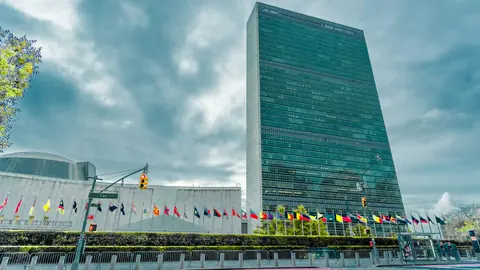
How Many Hours Would It Take to Learn All Six UN Languages?
Learning all six official UN languages is a classic polyglot daydream. Arabic, Chinese, English, French, Russian and Spanish would let you talk to a very large share of the world and follow the General Assembly without headphones. So how many hours would it actually take? Here's the honest arithmetic, using the U.S. Foreign Service Institute's published figures.
On this page
The numbers, language by language
FSI publishes how long its English-speaking students usually take to reach professional working proficiency (roughly upper B2 to low C1). Assuming English is your first language, you need the other five:
| Language | Cat. | FSI hrs | ~B1 |
|---|---|---|---|
| Spanish | I | 690 | 345 |
| French | I | 690 | 345 |
| Russian | III | 1,012 | 506 |
| Arabic | IV | 2,200 | 1,100 |
| Mandarin | IV | 2,200 | 1,100 |
| Total | 6,792 | 3,396 |
The “~B1” column is not an FSI figure. It's the rule of thumb this blog uses for a conversational level: about half the FSI hours. Our B1 hours guide explains where it comes from and why it's rough.
What 6,792 hours really means
FSI's hours are class hours. Its students also do about 17 hours of self-study a week on top of 23 hours of class, so 280 weeks of training is closer to 280 × 40 = 11,200 hours of total effort. And that's with full-time professional teachers, small classes and a job that depends on passing.
Spread over a normal life, the class hours alone look like this:
| Per day | FSI 6,792 h | B1 3,396 h |
|---|---|---|
| 30 min | 37.2 yrs | 18.6 yrs |
| 1 hour | 18.6 yrs | 9.3 yrs |
| 2 hours | 9.3 yrs | 4.7 yrs |
| 3 hours | 6.2 yrs | 3.1 yrs |
Arabic and Mandarin are 65% of the total on their own. Remove them and the other three come to 2,392 class hours, about 6.5 years at an hour a day.
What the math leaves out
- Overlap helps, but nobody has measured it. French after Spanish is easier than French from scratch: shared vocabulary, similar grammar. FSI's figures assume each language is learned from zero, so the real total for one person is probably lower. By how much, we don't know. Our post on third-language acceleration covers what research does say.
- Maintenance costs hours. Every language you've finished starts decaying while you work on the next. Budget some weekly time to keep each one alive; see maintaining multiple languages.
- Arabic is really two jobs. Modern Standard Arabic plus at least one spoken variety. FSI's 2,200 hours don't make you fluent in Egyptian and Gulf Arabic at once.
- If English isn't your first language, these numbers don't apply directly. FSI only publishes figures for English speakers, and nobody publishes a comparable table for, say, Spanish speakers learning Russian.
A plan that might actually work
The realistic version isn't six languages to C1. It's a few strong, the rest functional, done in sequence rather than all at once:
- Spanish to B2 (the cheapest big language).
- French to B2, while keeping Spanish ticking over. Back-to-back Romance languages share the most.
- Russian to B1.
- Arabic or Mandarin, whichever matters more to you. Be honest that this one is a multi-year project.
Running more than two at once usually slows everything down; see learning two languages simultaneously. If you're only going to pick one, read which UN language to learn first.
Check your own numbers
Pick any of the five and how long you study each day. Switch the goal between B1 and the full FSI figure.
The point of the arithmetic isn't to scare you off. It's to make the project concrete: once you're logging hours, you can see whether you're on a five-year plan or a twenty-year one, and adjust before it's too late.
FAQ
How many hours does it take to learn all six UN languages?
For a native English speaker, the U.S. Foreign Service Institute's figures for the other five add up to 6,792 class hours (280 full-time weeks) to professional working proficiency: Spanish 690, French 690, Russian 1,012, Arabic 2,200 and Mandarin 2,200. That excludes homework. Reaching a rough B1 in all five is about half that, around 3,400 hours.
Has anyone learned all six UN languages?
Some interpreters and polyglots work in several of them, but UN interpreters typically work from two or three languages into one, not across all six. Treat all six to a high level as a lifetime project.
Which order should I learn the UN languages in?
One reasonable order for an English speaker is Spanish, then French, then Russian, then Arabic or Mandarin: the cheapest first, and the two Romance languages back to back. It is a judgment call, not a rule.
Collecting languages?
Track each one separately and see hours, streaks and daily goals side by side. Free for one language; Pro tracks as many as you’re learning.
Track your languages — free