Best Chinese Crosstalk (Xiangsheng) for Learners, by Level
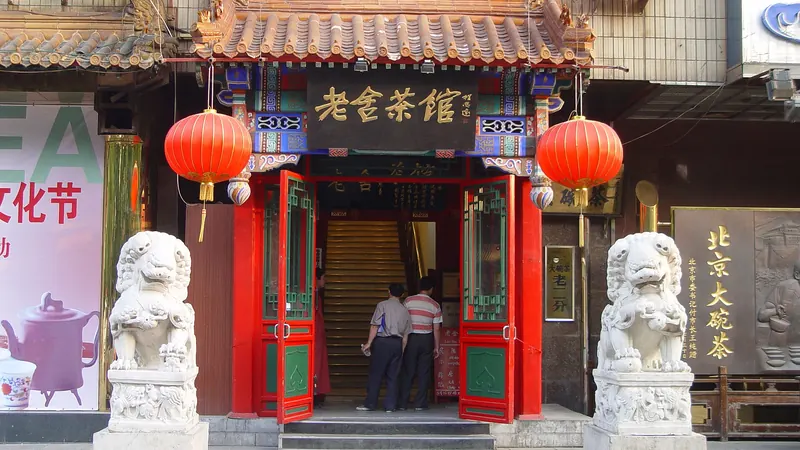
Chinese crosstalk, or xiangsheng (相声), is one of the hardest and most rewarding things an advanced Mandarin learner can listen to. Two performers trade jokes at high speed, in northern colloquial Chinese, with puns, tongue twisters and references to opera and history. This list picks ten pieces and shows, ordered from most to least accessible, with an HSK estimate and a note on what makes each one hard.
Quick picks: Warm up with Rock & Roast stand-up and Zhao Benshan's sketch Selling Crutches (HSK 5). Your first real crosstalk: Yue Yunpeng and Sun Yue's I Can't Take It from the 2015 Spring Festival Gala. Then the classics: Hou Baolin's Night Journey and Guan Gong Fights Qin Qiong (HSK 6+).
On this page
What is xiangsheng?
Xiangsheng is a traditional performing art that first appeared in Beijing in the 19th century, during the Qing dynasty's Daoguang era. It comes in three forms: solo (单口相声), duo (对口相声) and group (群口相声). The duo is by far the most popular. One performer, the 逗哏, drives the routine and tells the jokes; the other, the 捧哏, reacts, questions and sets up the punchlines. Routines are passed from master to apprentice, so the same classic piece may be performed by several generations.
In the second half of the 20th century, xiangsheng reached the whole country through radio and the CCTV Spring Festival Gala (春晚). Since the mid-2000s, Guo Degang and his troupe Deyunshe (德云社) have made live theatre crosstalk popular again with a young audience.
Why is xiangsheng so hard for learners?
Is xiangsheng good for learning Chinese? Yes, but only at an advanced level. Five things make it harder than a drama at the same nominal level:
- Speed and no visuals. It's almost pure talk, with nothing on screen to help you guess. Performers speed up into the punchline.
- Beijing and Tianjin speech. Heavy erhua (the 儿 suffix in 这儿, 玩儿), northern slang and imitations of regional accents. Hou Baolin and Guo Degang were born in Tianjin, and Ma Sanli spent most of his life there.
- Wordplay. Many jokes are puns on homophones or tones. If you don't hear the exact syllable, you miss the joke.
- Recited set pieces. The 贯口 is a long passage recited in one breath, often a list of names, places or dishes.
- Cultural references. Peking opera, historical heroes, and decades-old social satire. Classic pieces assume you know what life in 1950s Beijing looked like.
Levels below are our estimates, based on speed, vocabulary domain, dialect and whether Chinese subtitles are usually available. TV broadcasts such as the Gala normally carry Chinese subtitles, which makes them much easier than audio-only classics.
Crosstalk terms to know
| Chinese | Pinyin | Meaning | Note |
|---|---|---|---|
| 相声 | xiàngsheng | crosstalk | Second syllable is neutral tone |
| 对口相声 | duìkǒu xiàngsheng | duo crosstalk | The most common form |
| 单口相声 | dānkǒu xiàngsheng | solo crosstalk | Closer to storytelling |
| 逗哏 | dòugén | lead comic | Tells the jokes |
| 捧哏 | pěnggén | supporting comic | Reacts and sets up |
| 包袱 | bāofu | joke, laugh line | Literally "bundle" |
| 抖包袱 | dǒu bāofu | to deliver the punchline | "Shake out the bundle" |
| 贯口 | guànkǒu | rapid recited passage | Delivered in one breath |
| 说学逗唱 | shuō xué dòu chàng | talk, imitate, joke, sing | The four classic skills |
| 段子 | duànzi | routine, bit | Also "joke" online |
| 曲艺 | qǔyì | folk performing arts | The wider family |
| 返场 | fǎnchǎng | encore | Short extras after the main piece |
| 小品 | xiǎopǐn | comedy sketch | Acted, with props and costumes |
| 脱口秀 | tuōkǒuxiù | stand-up comedy | Modern solo form |
| 您 | nín | you (polite) | Used constantly on stage |
| 咱们 | zánmen | we (including you) | Northern; addresses the audience |
| 甭 | béng | don't, no need to | Northern contraction of 不用 |
| 去你的 | qù nǐ de | get out of here! | Classic closing line of a duo routine |
Warm-up: sketches and stand-up (HSK 5)
These aren't xiangsheng, but they're the best bridge to it: comedy in standard Mandarin with subtitles and visual context.
Rock & Roast 脱口秀大会
A televised stand-up competition in which comedians perform short sets on work, family, dating and city life, judged by guests and the audience. Five seasons aired from 2017 to 2022; a planned 2023 season was dropped after a controversy over one comedian's joke.
Why it works for learners: Sets are only a few minutes long, the Mandarin is close to standard, and the topics are modern everyday life. It teaches you how Chinese jokes are built (setup, twist, callback) before you face the speed and dialect of crosstalk. Watch with Chinese subtitles on Tencent Video; check your region.
Selling Crutches 卖拐
A smooth-talking northeastern con man (Zhao Benshan) persuades a perfectly healthy man (Fan Wei) that something is wrong with his leg, and that he needs to buy a crutch. It started a trilogy, followed by Selling a Car (卖车, 2002) and Kung Fu (功夫, 2005).
Why it works for learners: A sketch is acted, so you can follow the con from the faces and props. The language is the persuasive patter of a salesman, with northeastern flavour and repetition you can shadow. It's a famous piece, so you'll hear lines from it quoted.
Modern crosstalk (HSK 5–6)
I Can't Take It 我忍不了
Yue Yunpeng, a Deyunshe star born in Henan in 1985, performs this duo routine with his long-time partner Sun Yue. As the title says, it's built around things Yue claims he can't stand. It was his first crosstalk at the CCTV Gala, a year after he appeared there in a sketch.
Why it works for learners: Gala pieces are short, scripted for a national audience and broadcast with subtitles, so the dialect is toned down. Yue's style relies on timing and self-mockery more than dense wordplay, which makes it the gentlest real crosstalk on this list. His later Gala pieces (2019–2021) are good follow-ups.
A Salesman 一个推销员
Ma Ji (1934–2006), one of the key performers of the 20th century and the teacher of Jiang Kun, created this crosstalk sketch for the 1984 Gala. He plays a salesman making his pitch.
Why it works for learners: It was written for a national TV audience, so the Mandarin is clear and close to broadcast standard, which makes it easier than most classic duo pieces. It's also a window into early reform-era China, when selling and advertising were new comic material. Ma Ji's signature piece The Five Organs Compete (五官争功) is a good next step.
The classics (HSK 6+)
Night Journey 夜行记
A man who ignores every traffic rule buys a rickety bicycle for 28 yuan and rides it at night, with one mishap after another. The piece was written in the mid-1950s with Beijing traffic police, as a public safety campaign, and Hou Baolin's version became the classic.
Why it works for learners: Hou Baolin (1917–1993) is the most famous crosstalk performer in history, and this is one of his most accessible pieces: one clear storyline and physical comedy you can picture. The vocabulary is bicycles, streets and police, so it's concrete. The audio is old, so use a transcript if you can find one.
New Night Journey 新夜行记
Guo Degang's update of the classic: his hero builds a homemade vehicle, drives drunk and ends up in even worse trouble than Hou Baolin's cyclist. Guo, born in Tianjin in 1973, founded Deyunshe in 1995, and Yu Qian has been his partner since 2002.
Why it works for learners: Watching the old and new versions back to back is one of the best exercises in this list. You already know the skeleton, so you can focus on how Guo's faster, looser delivery and modern references change it. Yu Qian is a model 捧哏: listen to his short reactions, which are the most reusable phrases in crosstalk.
Buying Monkeys 买猴儿
A careless office worker named Ma Daha writes a sloppy instruction that sends a colleague off on an absurd errand to buy monkeys. The character became so famous that 马大哈 (mǎdàhā) is still everyday Chinese for a careless person.
Why it works for learners: You learn a word every native speaker knows, and its origin. Ma Sanli (1914–2003) spent most of his life in Tianjin and was admired for his relaxed, understated delivery and his 贯口. Expect old workplace vocabulary and a Tianjin accent; read a summary first.
Such Photography 如此照相
Set in a photo studio, this piece mocks the slogans and rituals customers had to follow during the Cultural Revolution. It made Jiang Kun famous; he later hosted the Spring Festival Gala from 1983 to 1989.
Why it works for learners: The jokes come from political language of the 1960s and 1970s, so it's a lesson in modern Chinese history as much as listening. Look up the period's set phrases before watching. Li Wenhua, his 捧哏, is a model of dry understatement.
Guan Gong Fights Qin Qiong 关公战秦琼
An opera troupe performing at a warlord's father's birthday is ordered to stage a fight between Guan Yu and Qin Qiong, two heroes who lived centuries apart. Hou Baolin adapted it from a piece by Tianjin performer Zhang Jieyao.
Why it works for learners: The title has become an idiom for absurd anachronism, so it's worth knowing. It draws on the full 说学逗唱, including sung Peking opera. Learn who Guan Yu and Qin Qiong are first; our advanced C-drama list has historical dramas that help with this kind of background.
Reciting the Menu 报菜名
A traditional routine whose centrepiece is a very long list of dishes, recited at speed. Performing it well takes breath control and very clear articulation, which is why audiences love it.
Why it works for learners: Treat it as a pronunciation challenge rather than comprehension practice. Find a transcript, learn a few lines and try to recite them at speed. Food vocabulary is useful, and the rhythm trains tones under pressure.
Watch order and summary
| Piece | Level | Speed | Main difficulty |
|---|---|---|---|
| Rock & Roast | HSK 5 | Medium | Modern slang |
| Selling Crutches | HSK 5 | Medium | Northeastern flavour |
| I Can't Take It | HSK 5–6 | Medium-fast | Timing, wordplay |
| A Salesman | HSK 5–6 | Medium | 1980s context |
| Night Journey | HSK 6 | Fast | Old audio, Beijing speech |
| New Night Journey | HSK 6 | Fast | Ad-libs, Tianjin speech |
| Buying Monkeys | HSK 6 | Fast | 1950s workplace, accent |
| Such Photography | HSK 6+ | Fast | Political slogans |
| Guan Gong Fights Qin Qiong | HSK 6+ | Fast | Opera, history |
| Reciting the Menu | HSK 6+ | Very fast | Recited list |
Where to watch legally: Gala segments are published by CCTV on its own platforms and official accounts. Deyunshe sells tickets for its theatres in Beijing and other cities and posts clips through its official accounts. Classic recordings by Hou Baolin and Ma Sanli are widely reissued on audio platforms. Look for uploads from verified official accounts, and check your region.
How to study a crosstalk piece
- Read a summary first. Knowing the setup lets you spend your attention on the language.
- Watch once with Chinese subtitles, pausing only when you miss a laugh. The audience laughter shows you exactly where the 包袱 are.
- Look up the punchlines. For each joke you missed, work out whether it was a pun, a reference or a dialect word. Note it.
- Shadow the 捧哏. His short reactions are the most reusable spoken Chinese in the piece.
- Rewatch a week later without subtitles.
A realistic plan: one 10–15 minute piece a week, about two hours of work including lookups and rewatching, alongside your other listening. If audio-only feels too hard, build up with our Chinese podcasts list and the talk-heavy picks in Chinese variety shows. More Chinese material is on our Chinese hub.
Track your listening hours
Crosstalk is slow going at first: a 15-minute piece can take an hour. Log those sessions in LangTrack and you'll see that time drop as your listening improves, along with how your advanced listening compares with the rest of your Chinese study.
Frequently asked questions
Is xiangsheng good for learning Chinese?
Yes, for advanced learners. Xiangsheng trains fast listening, northern colloquial Mandarin and wordplay, and it is full of cultural references. It is too hard below about HSK 5, so start with sketches or stand-up first.
What HSK level do you need for xiangsheng?
Around HSK 5 for modern Spring Festival Gala crosstalk with subtitles, and HSK 6 or above for classic pieces by Hou Baolin and Ma Sanli or traditional routines with long recited passages. These are estimates.
Who are the most famous xiangsheng performers?
Classic names include Hou Baolin, Ma Sanli, Ma Ji and Jiang Kun. Today the best known are Guo Degang and his partner Yu Qian, who lead the Deyunshe troupe, and Yue Yunpeng.
What is the difference between xiangsheng and Chinese stand-up?
Xiangsheng is a traditional form, usually performed by a duo with fixed roles and set routines passed down between masters and apprentices. Chinese stand-up (脱口秀) is a modern solo form built on personal stories, closer to Western stand-up.
Track your Chinese listening
Log every crosstalk, podcast and drama session and watch your advanced listening hours add up.
Start tracking — free